
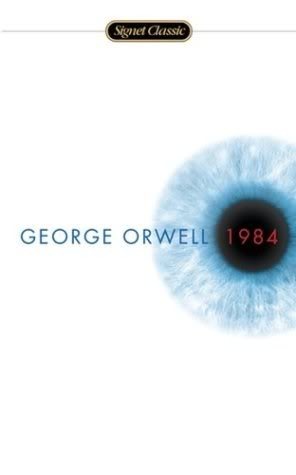
 "WAR IS PEACE. FREEDOM IS SLAVERY. IGNORANCE IS STRENGTH."
These are the words that define Oceania's society. Oceania is just one of three states that exist in the world following the second World War, and it is marked constant war with its neighboring states Eastasia and Eurasia (though they've only ever been at war with one of these states, according to the Party and their particular revisions to history on any given day), by intense regulation of human activity (including, but not limited to, emotions and thinking), constant monitoring by the all-knowing Big Brother (as well as fellow Oceania citizens and Thought Police), extreme punishment through brain washing and torture, and - in the end - the the destruction of the idea of free will (as well as all other ideas that do not match those of the Party's).
The story follows Winston Smith's fall from these societal parameters, and his attempt to start a small if not inspiring rebellion. It begins with him beginning a journal questioning the totalitarian government he has known for his entire life. This act alone could put Winston into the crosshairs of the Thought Police, but, of course, our hero does not stop there. Instead, he begins a romantic and sexual relationship with a woman named Julia (by the way, in Oceania, sex is restricted to only procreative ends - women, in particular, are not permitted to enjoy it) and forges an alliance with both her and a member of the Party's regime. Of course, inspiring as it may be to those with a rebellious heart, Winston's story is stocked full of fear, hate, love, betrayal, and - even in the final sentence - tragedy.
I know, I am super late to the party that is 1984. While I did see a production of the stage version of 1984 in high school, I can't tell you much about the theatrical production nor will I say that at any point in reading the novel did I stop and think, "Oh yeah, I remember that." Either I was too young to appreciate the stage version, or that particular production of the stage version just didn't stick with me. I imagine it's a combination of the two.
I've mentioned in previous posts that I am, in general, not a fan of the dystopian genre. I will say that I agree with this statement still, but the idea of a "negative utopia" - which is how Erich Fromm defines 1984's genre in the afterword of this edition - really made me pause, because it seems so realistic. The very idea of Utopian society is a difficult one to fathom, because most people can't even agree on where they all want to go eat - how could an entire populace agree upon what would make a perfect society? It would mean having to agree on all social issues, religious or secular beliefs, and fiscal decisions. In our society today, we can't even agree on whether the Women's March was valid - even though our right to assemble peacefully is guaranteed in our Constitution - but I digress. As a result, the idea of a negative utopia seems realistic in that, even with the best intentions (which I would not accuse the Party of having in Oceania), there can never be such a thing and, if you try to create a Utopia, you're likely to end up with something resembling a negative Utopia.
What makes this novel different for me is that while it is considered dystopian or "negative Utopian" - it is utterly horrifying in a way most dystopian novels I have encountered thus far are not. Perhaps I should have seen The Hunger Games or The Stand as more terrifying than I did (and, yes, I know I am grossly oversimplifying the genre), but there's something so tangible and realistic about 1984 that truly makes it stand out against others of its genre. Somehow, it has escaped the label of horror, but there are few books on my shelves (of mostly horror novels) that have scared me the way 1984 did.
Perhaps it's a combination of both the political climate we find ourselves in now (see Kellyanne Conway's "alternative facts"), as well as the recent deluge of conspiracy theories surrounding our newly inaugurated president, but 1984 hit me in a way I was not expecting. What really stuck with me throughout 1984 was not necessarily the idea of controlling humans to such an extreme extent (though that certainly did resonate with me), but rather this idea of revising the past and facts and forcing everyone to conform to it, even if they were around to witness the real history (again, see "alternative facts"). There is a certain comfort in knowing that facts do not change in our society - the facts are the truth and there's no changing the truth. When we remove the idea of truth from society, what more are we left with other than uncertainty and despair?
It is a beautiful novel, full of the very universal (I hope) belief in the human experiences of gaining knowledge, loving others, and seeking to do the best we can. Of course, it's these very themes that make the novel all that more tragic in that, in the world of Oceania, most people have lost the ability to think, love, and do good and, if they somehow do, there are structures in place to ensure they comply with Big Brother.
A salient novel for our time, 1984 is the perfect read - and, is it too strong to say (?), the most responsible read - for right now whether you've read it before or, like me, you are picking it up for the very first time. Sadly, Orwell's vision of the future - while not recognized in the hair scrunchies and neon colors of the 1980s - is still so relevant because it is still, somehow, possible.

No comments:
Post a Comment